В Серпухове покажут живопись братьев Дмитренко
Выставка «Интеллектуальный реализм» пройдёт в галерее «Каретный сарай» с 17 октября по 8 ноября 2026 года.
Галерея «Каретный сарай» · Серпухов

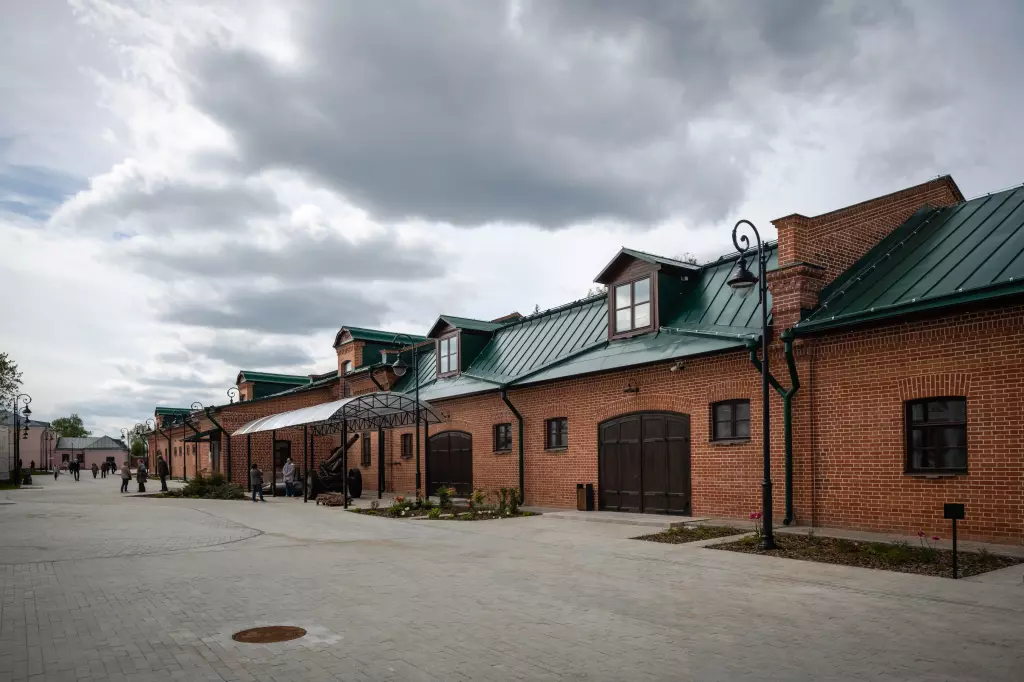
On the north side of the Maraev town estate is a large stone one-story complex of buildings that previously belonged to the manor farmyard. The buildings were built in stages from the end of the 19th century to the 1910s.
In 1916, a single complex of buildings was formed from individual buildings, each of which included several rooms for various economic purposes. A wooden poultry house and cellar were added to the northern building, where the carriage house and stable were located, from the western end.
On the hip roof, which was roofed with iron, the dormer windows were decorated with carved decorative elements in the form of sawn carvings. In the first building, the rooms were covered with vaults on beams. In all the others, flat wooden ceilings were used along wooden beams.
There was a hayloft in the attic of the second building, and the first floor housed a warehouse and another stable with a carriage house. The premises farthest from the house were given to the spinning and weaving factory of the A.V. Marayeva Manufacturing Association in Serpukhov, located next to the factory yard of the estate, for the needs of the packaging and carding departments. Cotton fiber in the form of lumps of various sizes with impurities came here from the trepanning shop. In the carding department, the fiber was combed, laid out in parallel along the length, while simultaneously being cleaned of impurities, black dots, and short fibers, and strand ribbons were produced, which were sent to the next stage of processing — torsion.
Behind the carding department, a stone bathhouse for workers was built with a wooden iron-roofed extension for undressing.
According to the inventory, there were household carriages in one of the carriage houses: a cab, two charabans, a tarantass "with a basket", a droshky for warm weather and eight sleighs for winter. The coachmen's winter and summer clothes were also stored here: fur coats, undercoats, tank tops, belts, gloves and hats. The stable with stalls and stalls (data for 1916) contained a racing (hunting) horse named Swallow, a team horse named Brick, and two "white bald" horses (with large markings on their muzzles) for a pair team. In the second carriage house there were work carts, shelves and luggage sleds, and in the adjacent stable room they kept work horses.
In 1950-1970, the buildings were in use by the Agricultural Machinery and Agrochemcenter enterprises, which led to their redevelopment and serious structural changes with partial disassemblies that greatly distorted the original appearance. In 1988, by the decision of the Serpukhov Executive Committee of the City Council, the Carriage House building, along with the Pokrovsky Old Believer Church, which is also part of the historical architectural and artistic complex of the Maraev city estate, was transferred to the Serpukhov Historical and Art Museum along with the adjacent territory.
The restoration of the facility began in 2020, and was completed in 2023: the building was restored to its historical appearance, and the estate acquired a holistic appearance. Now the space has been given over to exhibition halls and is capable of hosting the most modern exhibitions. The opening took place on December 20, 2023, with the intermuseum exhibition "Makovskiye. Konstantin and Vladimir." Open storage facilities for sculptures and rare books are available in the Carriage House space, as well as the museum's library, which was previously inaccessible to the general public. The opening of the gallery allowed for the creation of even more intermuseum projects and temporary exhibitions.
After the restoration (2020-2023), plastered areas were specially left in the premises and on the facades of the building, allowing for a detailed examination of the original ancient brick masonry of the 19th century. This solution gives visitors the opportunity to see authentic construction equipment of that time and to imagine the historical appearance of the building.
Additional interesting details:
The Monier vaults have been preserved in the building — a special type of brick floors with cylindrical arches of a small span, characteristic of the economic architecture of the late 19th century.
The original herringbone floor, made of bricks laid on the end, has partially survived. It can be seen in the part of the building where the coachroom was located.
During the work, artifacts were found: plaques with the inscriptions "Anna Marayeva's Barn" and "Dor" (probably from the stall door), as well as the burial of a horse.
At the opposite end of the building, the furnaces from the former bathhouse, which was located here in the manor days, have been preserved; now this space is used by the Museum cafe.
Выставка «Интеллектуальный реализм» пройдёт в галерее «Каретный сарай» с 17 октября по 8 ноября 2026 года.
Галерея «Каретный сарай» · Серпухов
С 7 октября по 8 ноября 2026 года в кафе «Музеум» при галерее «Каретный сарай» представят проект фотографа и художника Надежды Седовой.
Галерея «Каретный сарай» · Серпухов